
Clear Results: The Beginner's System for Selling Resin Jewelry on Etsy
For anyone whose starter kit produced cloudy, bubbled, or tacky results and who wants to know exactly why before spending another dollar on supplies
Without watching another tutorial that shows the pour and cuts to a perfect pendant, without shooting pieces on a kitchen counter under overhead lighting, and without pricing from the Etsy average and losing money on every order
30-day money-back guarantee: if the pricing formula doesn't pay for the book on your next order, I'll refund it. No questions.
Beginner Friendly
No experience needed
Kitchen Table Business
No studio or expensive setup
Step-by-Step System
Clear & easy to follow
Built for Etsy Sellers
Products people actually buy

My name is Melissa Carr. I live in Bozeman, Montana. I’ve been a dental hygienist for fifteen years.
I am not artsy. I am organized. That distinction is the whole reason this book exists.
In 2021, a coworker brought a pressed wildflower pendant to the office on a lunch break. She’d made it over a weekend with a $28 kit from Amazon. I bought the same kit on my phone before lunch ended.
My first three pieces were bad. One cloudy. One with two bubbles frozen in the surface. One that stayed tacky after two minutes under the lamp. I put all three in a drawer.
Nobody told me what went wrong. The kit instructions didn’t say. The tutorials showed success and assumed I’d get there too.
The fourth piece was a small larkspur pendant, crystal clear. I posted it on Etsy at eleven at night. It sold in 48 hours. This first successful sale showed me the possibility of earning an extra $68 early on.
If I didn’t know why piece four worked, I couldn’t repeat it. I spent a week figuring out what went wrong with the first three and what worked with the fourth. The answer wasn’t talent. It was resin type, lamp wattage, and pour procedure. All fixable. All teachable.
Over time, I was able to build toward the possibility of clearing an extra $1,200 working evenings, and eventually built toward the possibility of an extra $3,800 to cut my dental hours. This book is that information, handed to you before your first pour.
What You Get
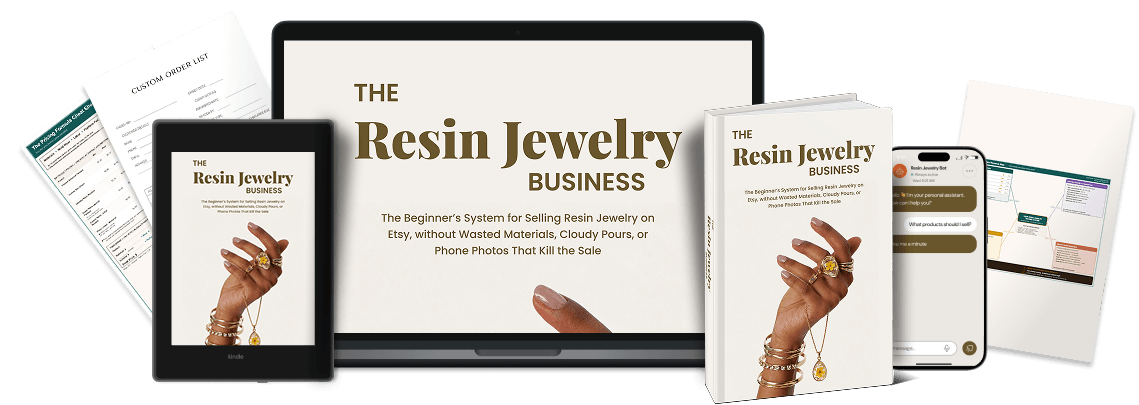
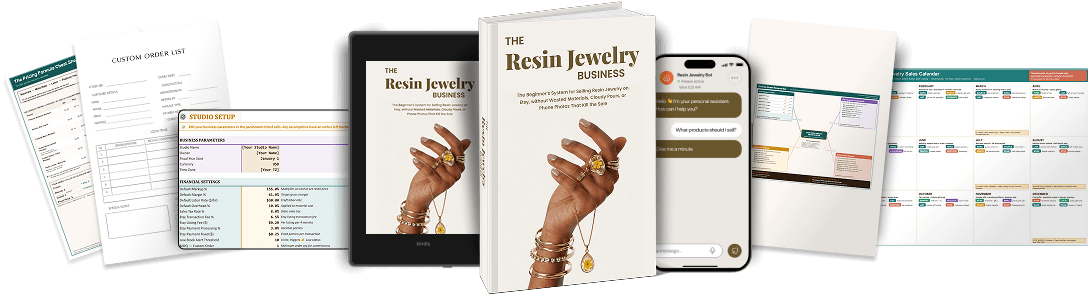
This is what Clear Results includes at $27:
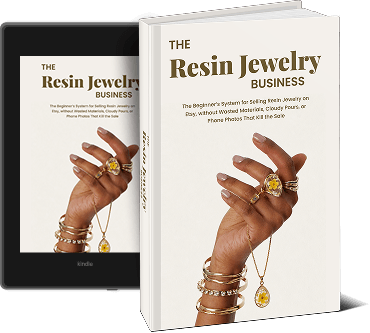
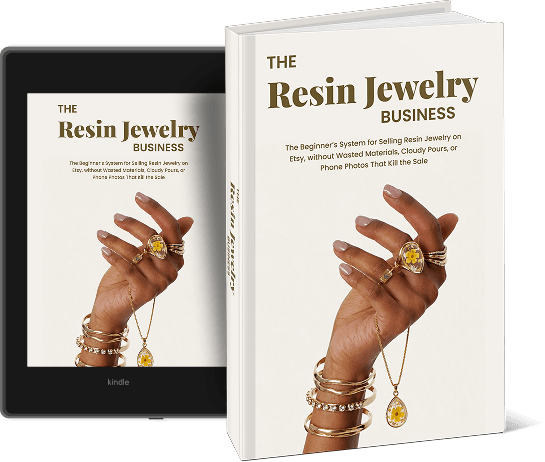
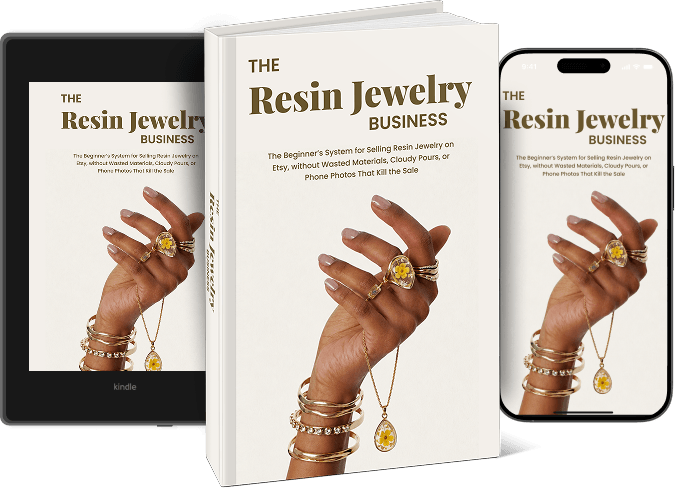
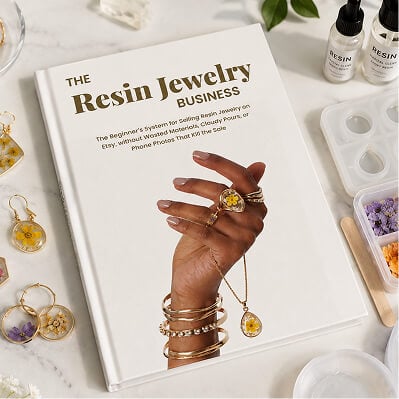
The Resin Jewelry Business eBook
If you’ve put a failed piece in a drawer and blamed yourself, this is where that stops. The complete seven-part system: why pours fail and how to fix them, UV versus epoxy decoded, the six products that actually sell, mold sourcing, a ten-line-item pricing model, Etsy shop setup, and custom orders that don’t fall apart.
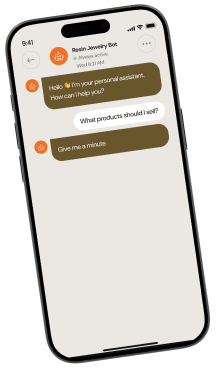
Your Personal Resin Business Advisor
This AI advisor is trained on the system in this book. The mid-pour questions, the pricing questions, the custom order questions answered without going back through the chapters.
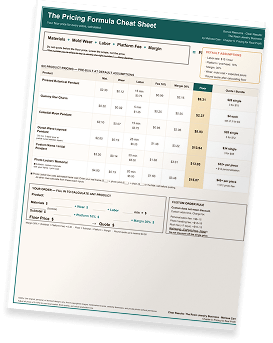
The Resin Pricing Cheat Sheet
The pricing formula on one page. Real cost and sell price for each of the six products, with a fillable model so you know your floor before you quote.
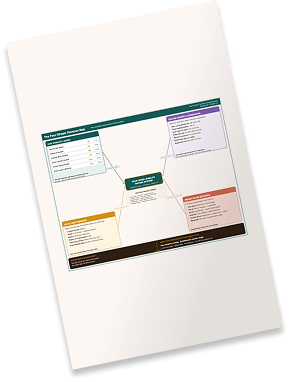
The Revenue Starter Mind Map
A one-page PDF that lays the whole business out at a glance: standard Etsy sales, custom and photo locket orders, your direct buyer list, and repeat and gift business. One page, four streams, so you can see where the money actually comes from before you decide where to put your hours.
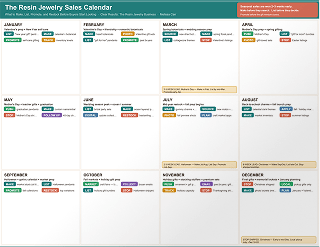
The Seasonal Sales Calendar
A dedicated month-by-month PDF you can print and pin near your work table. Which of the six products to have stocked and ready before Valentine’s Day, Mother’s Day, wedding season, and the holiday window hits, so you’re not starting production the week demand peaks.
30-day money-back guarantee: if the pricing formula doesn't pay for the book on your next order, I'll refund it. No questions.
What the Kit Doesn't Include
If you bought a starter kit, made one cloudy piece, and stopped, the kit was probably working against you. Not your hands.
- Pressed botanical pendants
- Gummy charms
- Celestial pieces
- Layered ocean drops
- Custom name pieces
- Photo lockets
Those are the six products that move on Etsy. What’s missing isn’t a creative gift. It’s the system around the kit you already own.
Two Weeks Running Epoxy Under a UV Lamp
My starter kit said “crystal clear UV craft resin” in the listing title. The bottle inside had no mixing ratio printed on it. It said “fast cure.” I assumed fast cure meant the UV lamp.
It didn’t. The kit shipped epoxy resin, a two-part product that cures over hours at room temperature and ignores a UV lamp entirely. “Craft resin” is not a resin type. It’s a marketing category that puts both kinds in the same search results.
I spent two weeks pulling out tacky pendants. One forum post. One product swap. The problem disappeared in my next pour. Every failure between piece one and piece twelve had the same cause, and none of it was about me.
Three Problems. Three Specific Causes.
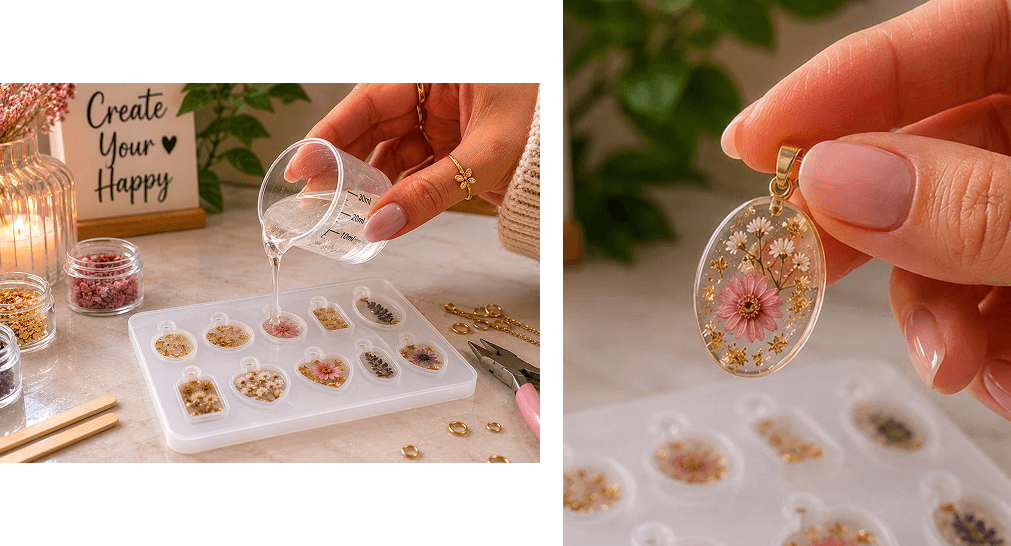
The kit is in the drawer. You’re probably telling yourself you’re not patient enough, or resin isn’t for you, or the quieter version that you’re the kind of person who starts things and doesn’t finish them. None of that is accurate. Each failure has a specific cause and a specific fix. That’s where this book starts.
Most beginners blame themselves for a cloudy first piece. The real cause is moisture in the mold, an underpowered lamp, or epoxy where they needed UV resin. Three fixable causes. None about skill.
Most beginners price by copying the middle of the Etsy range. In my third month I sold pendants at $22 and learned later I was netting $2.60 a piece. That’s $10.40 an hour. Below Montana minimum wage.
Most beginners shoot on a kitchen counter under the ceiling light because it’s convenient. Convenient produces invisible. A $40 pendant photographed badly looks like a $6 pendant.
Three problems. Three fixable causes. That’s what the book is built around.
The Pour-to-Profit Method
Seven parts, in sequence. Each one depends on the one before it: diagnosis, right resin and lamp, right products, right molds, real pricing, a shop that gets found, custom orders that don’t lose money.
Most beginners who fail at Etsy fail at the same step: they skip ahead before the foundation is in place. This book closes each gap in the right order.
-
Why your bracelet came out cloudy, and the fix.
A symptom-cause-fix table for every failure mode. Chapter 1 lets you name exactly what went wrong before you buy anything new. -
UV versus epoxy, settled.
How to tell which one your kit shipped, why a 36-watt lamp fixes the tacky-surface problem, and why UV resin gives you feedback in 90 seconds instead of 24 hours. -
The six products that sell, with the cost and price of each.
Pressed botanicals, gummy charms, celestial, ocean, name pieces, photo lockets. Why "pressed lavender pendant" beats "resin jewelry." -
Pricing that doesn't quietly lose money.
The ten-line-item model that counts resin, findings, chain, fees, and your own time. The $7.67 cost behind a $32 pendant. -
An Etsy shop that gets found.
Keyword research with a free tool, a title formula buyers actually type, and a $35 lightbox that takes four minutes to set up.
30-day money-back guarantee: if the pricing formula doesn't pay for the book on your next order, I'll refund it. No questions.
Where I Am Now

The framework built in this system can open up the possibility of an extra $3,400 in revenue, working about four to eight hours a week from my kitchen table. Almost all of it from Etsy plus a small direct list of buyers I can reach without paying for the privilege.
That’s the steady state. It is not month one. Over time, I was able to build toward the possibility of an extra $1,200 working evenings, and eventually built toward the possibility of an extra $3,800 to cut my dental hours.
Building toward the possibility of an extra $3,000 consistently takes steady weekly production time. This is a part-time business, not passive income. I will not tell you otherwise anywhere in this book.
In My Third Month,
I Was Netting $2.60 Per Pendant
Most beginners leave their own time out of the math. They count the resin and the mold and forget the fifteen minutes of prep, pour, cure, findings, photography, and listing.
A pressed botanical pendant costs $7.67 to make and sell. Listed at $32, that’s $24.33 in net margin, about 76 percent of the sale price.
pressed botanical pendant
$7.67
Listed at
$32.00
net margin
$24.33
percent
76%
The first time you run the worksheet it feels slower than guessing. After that it gives you a price you can publish without flinching.
30-day money-back guarantee: if the pricing formula doesn't pay for the book on your next order, I'll refund it. No questions.

My First Custom Order Went Wrong in Every Preventable Way
A pet-portrait locket for a buyer’s late dog. She wanted a specific chain length, a price match to another shop, and it done in seven days. I said yes to everything.
I priced a $76 piece at $38. The pour took three hours instead of 45 minutes. It arrived two days after the birthday.
Every mistake was preventable. None of them needed skill I didn’t have. They needed a system I didn’t have yet. Five intake questions before any yes. A non-refundable deposit. A stated turnaround in business days. Chapter 7 hands you the whole thing before your first inquiry shows up.
Owning your buyers beats renting Etsy traffic.
I won’t teach you to become a content person.
At a small Etsy sellers’ conference in Denver, a speaker talked about what he called the email gap or the distance between what craft sellers make and what they could make if they owned their customer list. Afterward, he pulled up my shop. Fourteen hundred sales. Zero email subscribers. He said the money was leaking out right there.
Every one of those 1,400 buyers came through Etsy search. Not one had given me a way to reach them directly. He walked me through a lead magnet and a short follow-up sequence. I built it over a weekend. Within 90 days I’d converted 380 opt-ins into $9,600 in direct sales on top of my Etsy income.
A buyer who orders a birthday locket in March has another birthday in her circle in six months. The book shows you how to stay reachable without being strange about it.
30-day money-back guarantee: if the pricing formula doesn't pay for the book on your next order, I'll refund it. No questions.
The highest-return work isn't where you'd guess.
The best margins I make aren’t on the cheapest, fastest pieces. They’re on photo lockets and custom orders.
A photo locket is a clear resin piece with a photo embed, usually a pet portrait or a memorial. Buyers pay $45 to $85 because the photo is irreplaceable and the piece is almost always a gift. Cost to make runs $3.50 to $6.50. My repeat-buyer rate on custom orders is 28 percent within a year, at a price point standard pieces never reach.
Prep the locket bases in advance, and a 45-minute piece becomes a 20-minute piece once a photo arrives. That’s the difference a system makes.
30-day money-back guarantee: if the pricing formula doesn't pay for the book on your next order, I'll refund it. No questions.
Why $27
Because this information is usually buried inside a 40-hour course with no clear starting point, or scattered across a hundred tutorials that each show one trick and skip the cause.
This book is the starting point. Every chapter is a decision you make before the next one makes sense.
Start at chapter one. The system handles the rest.
30-day money-back guarantee: if the pricing formula doesn't pay for the book on your next order, I'll refund it. No questions.
What's in the Book:
- Why your first piece came out cloudy, bubbled, or tacky, and the specific fix for each
- How to tell in ten seconds whether your kit shipped UV resin or epoxy
- Which six resin products actually sell on Etsy, and which to make first
- What to charge using a cost model that counts your own time
- How to source molds that last 100-plus uses instead of tearing at 30
- How to photograph a pendant with a phone and a $35 lightbox
- How to write Etsy titles around what buyers type, not what makers say
- How to take custom orders without losing money on the first one
That last part is production guidance, not a guarantee of results. What you earn depends on your products, your pricing, your consistency, and your market.
30-day money-back guarantee: if the pricing formula doesn't pay for the book on your next order, I'll refund it. No questions.
If the Kit Is Still in the Drawer
The bracelet came out cloudy because the kit shipped the wrong resin for the process the tutorials were showing you. Chapter 1 names the cause and gives you the fix before you touch the mold again.
My sister-in-law bought $400 in resin supplies, made three bad pendants, photographed them in bad lighting, listed them on Etsy, sold nothing in five weeks, and quit. She had no system and no explanation for why the first three pours went wrong.
Six months from now, without this book, the kit stays in the drawer. The next $80 in supplies produces the same result. That’s not a talent problem. It’s an information problem.
You have the information now. The kitchen table is already there.
30-day money-back guarantee: if the pricing formula doesn't pay for the book on your next order, I'll refund it. No questions.
Earnings note: The potential income figures mentioned represent my own results after the system was built. They are achievable, not average, and not guaranteed. Resin jewelry requires consistent weekly production time. Your results depend on your products, pricing, consistency, market, and follow-through.
1. Your Info
Your Order Info
2. Payment
Your Payment Details
You’ll get an order confirmation and download link by email.
What’s Included
- The Resin Jewelry Business eBook
- Your Personal Resin Business Advisor
- The Resin Pricing Cheat Sheet
- The Revenue Starter Mind Map
- The Seasonal Sales Calendar